
Sorry, Oprah, But There Isn’t a “No Contact Trend”
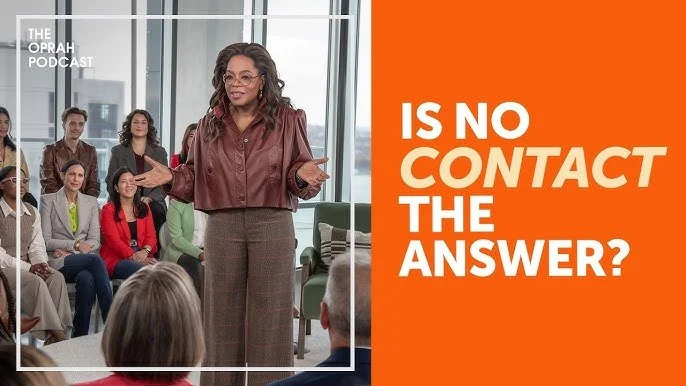
Image obtained from the Oprah YouTube account
Like many of you, I have seen the clips from Oprah’s podcast episode on the “No Contact Trend.” If you haven’t- basically she had a few people who have gone no contact with family members as well as people whose family members have gone no contact with them. They discuss the impacts of the no contact and individual reasons why they have gone no contact.
I hated it.
The framing of no contact or reduced contact as a “trend” is pedantic and dismissive. “Trends” are for hairstyles and jean cuts, not for the deeply personal and immensely nuanced dynamics and decisions within relationships between parents and children. It honestly felt like propaganda to further frame those who have made the extremely difficult decision to end contact with their parents as petulant children who didn’t get what they wanted on their 5th birthday so now they are punishing their parents. While Oprah has been the right person to discuss complex issues in the past, this one is an issue she should have left to someone else.
Going No Contact is Against Evolution
Evolutionarily we are a connective species that relies on one another for survival. There are studies that have shown that people suffer severe mental and physical repercussions and sometimes, death without emotional connection and reciprocity.
Researcher René Spitz (1940) observed infants experiencing abrupt separation from their primary caregiver(s) due to incarceration or war. Through these observations he coined the terms “anaclitic depression” or “hospitalism”. This is where infants that were abruptly deprived of emotional bonding and affection from their primary caregiver, while still getting their physical needs met, develop severe developmental, psychological, and physical issues; some of which even died. Spitz observed that when the primary caregiver was returned within three to five months, there was a drastic recovery for the infant, however after the five month mark, the infants showed significant and serious deterioration.
While, yes, Spitz’s studies are both old and on infants and I am not familiar with any infants who have gone no contact with their parents, it does highlight the biological need to be emotionally and physically connected, specifically with our family of origin. When someone makes the decision to go no contact, they are pushing back against this biological urge, which is a difficult and painful process.
When people decide to go no contact it is more often than not following years of attempts at repair, compromise, and communication that has consistently failed. For many, the lens is turned inward, blaming themselves for some flaw that has resulted in their parents’ lack of respect and kindness. These people try their best to “fix” whatever is wrong with them that keeps their parents/loved ones hurting them. “Maybe I’m too sensitive,” “maybe I just need to let it go,” “is it really THAT bad?” Questions and scenarios that these adult children play out in their minds on repeat. Because at the end of the day, no contact is the final option. I call it the “break the glass” decision- when things are just so clearly never improving, if anything, getting worse, and the individual needs to take care of themself.
It’s Not About Punishment, It's About Safety
So often, the narrative about children going no contact is that they are trying to punish or manipulate their parents to behave how they want them to. Again, this puts the adult child in the role of abuser and the parent in the role of victim, which is an inaccurate portrayal of the relationship. No contact is actually not about the parent at all- it's about the child. It's about the realization that the parent won’t be changing, that the relationship will never feel safe, and that staying it in will only do the child more harm.
Another misconception is that these adult children are angry about things that happened to them as children and thus are now punishing their parents for those past actions. They “can’t let it go.” Oftentimes this does not give the full picture of what led to no contact. For most, yes, these boundary violations and lack of consideration started at a young age for the child. When it begins, children often don’t have the understanding, language, or safety to understand and express the hurt they are experiencing and what needs to change. Remember, children are fully dependent on their parents to meet ALL of their needs. This power differential limits their ability to advocate for themselves as they get older, especially when parents may still wield power over their finances, their living situation, or access to healthcare.
As we age, our relationship with our parents is going to naturally and expectedly change. The natural course of development moves children from full dependence on their parents, to full independence from them (psychological, economical, physical, etc). When this independence happens, we start to evaluate the relationship with our parents. It is no longer a relationship of necessity, but rather a relationship of choice. And when we see that we have a choice in whether or not to engage in that relationship, we naturally start to evaluate what about the relationship works for you and what doesn’t.
When the now adult child sees dynamics that do not work for them, start to advocate for change in their relationship, and their parents either push back, refuse change, or many times, increase abusive behaviors, the child is faced with a decision. Do I stay in this dynamic that is clearly hurting me and not going to change, or do I protect myself, my partner, my family from this damage?
The Problem With Parents
The problem with parents is the message they were given around what the responsibilities of parents are. Many parents were told that their job is to house, clothe, educate, feed, and raise their children. That is it. There was no messaging around emotional support, connection, vulnerability, safety, etc. The expectation was if I meet your basic needs, then I should have full, unlimited, unconditional access to you as an adult. Children were not seen as autonomous individuals but rather subordinates to their parents- something to be shaped and controlled, rather than respected and fostered. The expectation of unconditional respect was never a two way street, but rather a unilateral mandate, which any deviation from the expectations of the parent would be viewed as a violation of.
Take spanking as an example. Thankfully, there has been a sharp cultural shift in many groups away from physical abuse as a means of “parenting.” Time and time again, parenting research shows the severe trauma inflicted upon children who were spanked or received "corporal punishment” as well as the significantly negative socioemotional outcomes for these children. However, there are many parents who still believe that spanking when a child does not do what you want is the best way to “teach” them “respect.” I ask you to imagine asking your barista to put cold foam on your coffee and when you see they didn’t do that, you reach across the counter and slap them. What do you think might happen in this scenario? You would likely get charged with assault, could face fines, a lawsuit, and jail time. This is a cultural expectation when someone assaults another person, regardless of their reasoning. So then why is it assault when you hit another adult but when you hit a child its “discipline”?
Not all abuse perpetrated by parents is physical. Many times, it isn’t even intentional. But intentionality, while it matters, does not negate the impact of behavior on others. And when someone, even your child, is holding you accountable for your behavior, it is worth a genuine listen, respect, and commitment to change. When that does not happen, it is completely reasonable for the adult child to take necessary steps to protect themselves from you.
I know this was a long post, so if you’re still with me, I appreciate it! As a therapist, I work with people every day who are navigating this painful decision about reducing or eliminating their relationships with family members. I see the hurt, confusion, and betrayal as they try to make sense of the behaviors and come to terms with the impacts those behaviors have had on their life and perspective of self. This is far from a “trend” or a “punishment.” No contact is the result of a generation of parents who have refused to address their own traumas, burdened their children with carrying and managing their emotions, and when confronted with the decimation their behaviors have made, double down, refuse to accept accountability, and expect everyone around them to stay silent. The quality of parent you are is not something you get to decide- your performance review is how your adult children feel about you and the relationship YOU are responsible for having built. And if the performance review results in no contact, try for a moment to turn your critical eye inward and see what you could have done differently then and now.
