
Anxiety, My Worst Best Friend
Every therapist I know is familiar with this statement from their patients:
“I'm so anxious and I just can't get it to go away.”
Anxiety is one of the most common reasons people seek therapy. Many of us spend years of our lives trying to control, minimize, and rid ourselves of the sudden increased heart rate, tension throughout our chests and our bodies, racing thoughts, hyperventilation, and feeling of impending doom.
And that makes sense, right? I don't know anyone who sits back and thinks “Wow I'm so glad it feels like the world is falling apart around me.” Troublesome anxiety is so disruptive to our ability to remain present, enjoy our lives, and maintain fulfillment and because of that, the goal of eliminating our anxiety feels reasonable. Humans are, by nature, stress avoidant, so if there is a way to avoid one of the most emotionally, psychologically, and physiologically distressing sensations, then why not?
Can you see why the pharmaceutical companies have made so much money off of benzodiazepines like Xanax?
So when a patient sits across from me and talks about how badly they want to rid themselves of anxiety, I have the unfortunate task of telling them that this is actually impossible.
I recognize that this is where I may have lost many of my readers, and that's okay. Again, it makes sense why we would become so invested in the possibility of eliminating anxiety. However, it's important to understand the function that anxiety plays in our lives in order to understand why full elimination is unrealistic.
Anxiety is an Evolutionary Adaptation
Eons ago when the first ancestors of modern day humans were realizing the efficiency of walking upright and developing the foundations of modern day language, anxiety kept them alive.
Anxiety is our body’s alarm system. Without it, we are at risk of doing and experiencing things that could be physically and emotionally harmful to us. Keep in mind, our brain's primary goal is to keep us safe. So the ancestors whose bodies released anxious responses to perceived threats resulted in them protecting themselves in one way or the other and being able to pass their genes along to the next generation. Those without the anxiety stress response, died before they were able to pass their genes along. After centuries of this process occurring, anxiety became an evolutionary adaptation that allowed our species to persist.
The problem is that writing an email to a coworker isn't as threatening as a saber tooth tiger was to our ancestors but many of our bodies don't recognize the difference. This is what brings people to therapy trying to rid themselves of anxiety
The Nervous System and Anxiety
Anxiety’s origins are tied to our autonomic nervous system and its two branches, the sympathetic and parasympathetic nervous systems. Most of us have heard the term “fight or flight.” Well that is the sympathetic nervous system in a nutshell. The sympathetic nervous system receives sensory information from the hypothalamus and a part of the brain stem called the medulla oblongata (cue Adam Sandler in ‘The Waterboy’).
An easy way to understand this is that information is taken in through these two structures, which is then sent to the autonomic nervous system to interpret safety -v- danger. The autonomic nervous system then responds to that information by triggering emotional, physiological, and hormonal changes to elicit appropriate responses.
The two branches of the autonomic nervous system have opposite roles, which influence one another.
The sympathetic nervous system (also known as the stress response) mobilizes the body for action and survival. When this happens your heart rate and blood pressure will increase, your airway and pupils will dilate, digestion will shut down or slow, and your muscles will tense.
The parasympathetic nervous system (also known as the rest and digest response) focuses on energy conservation and body repair. It reduces your heart rate and blood pressure to conserve energy and returns your breathing and pupils to their baseline states, while stimulating digestion and relaxing muscle tension.
The sympathetic nervous system releases adrenaline and cortisol while the parasympathetic nervous system releases acetylcholine.
For example; If I'm walking in the woods and ahead of me I see something in the middle of the path that is long, thin, and in an ‘S’ shape, my brain may interpret that as a snake. If I am afraid of snakes then my autonomic nervous system will trigger the sympathetic nervous system into fight or flight. As I get closer, I may recognize that it is actually a stick and not a snake. when my brain realizes I'm no longer in danger, it will trigger my parasympathetic nervous system.
Anxiety as a Motivator
While anxiety certainly motivates us to protect ourselves and stay safe, at lower levels it can motivate us to engage with necessary tasks.
If I am not a little anxious about paying my bills, I'm not going to find a job that can cover my expenses. If I'm not a little anxious about failing a class, then I am not going to study for a test. Have you ever met someone who says that they do their best work when they're under pressure? that is because when their deadline is fastly approaching their anxiety increases to a point where it motivates them to get the work done, whereas prior to that their anxiety may have been too low for it to motivate them.
Anxiety and productivity have a relationship that Ismutually beneficial to a point. The graph below shows that as anxiety increases from lower levels so does productivity until it reaches an optimal point. is optimal point is the right amount of anxiety to be the most productive. However when anxiety continues to increase past that optimal point we see an inverse relationship where productivity actually declines with the rise of anxiety.
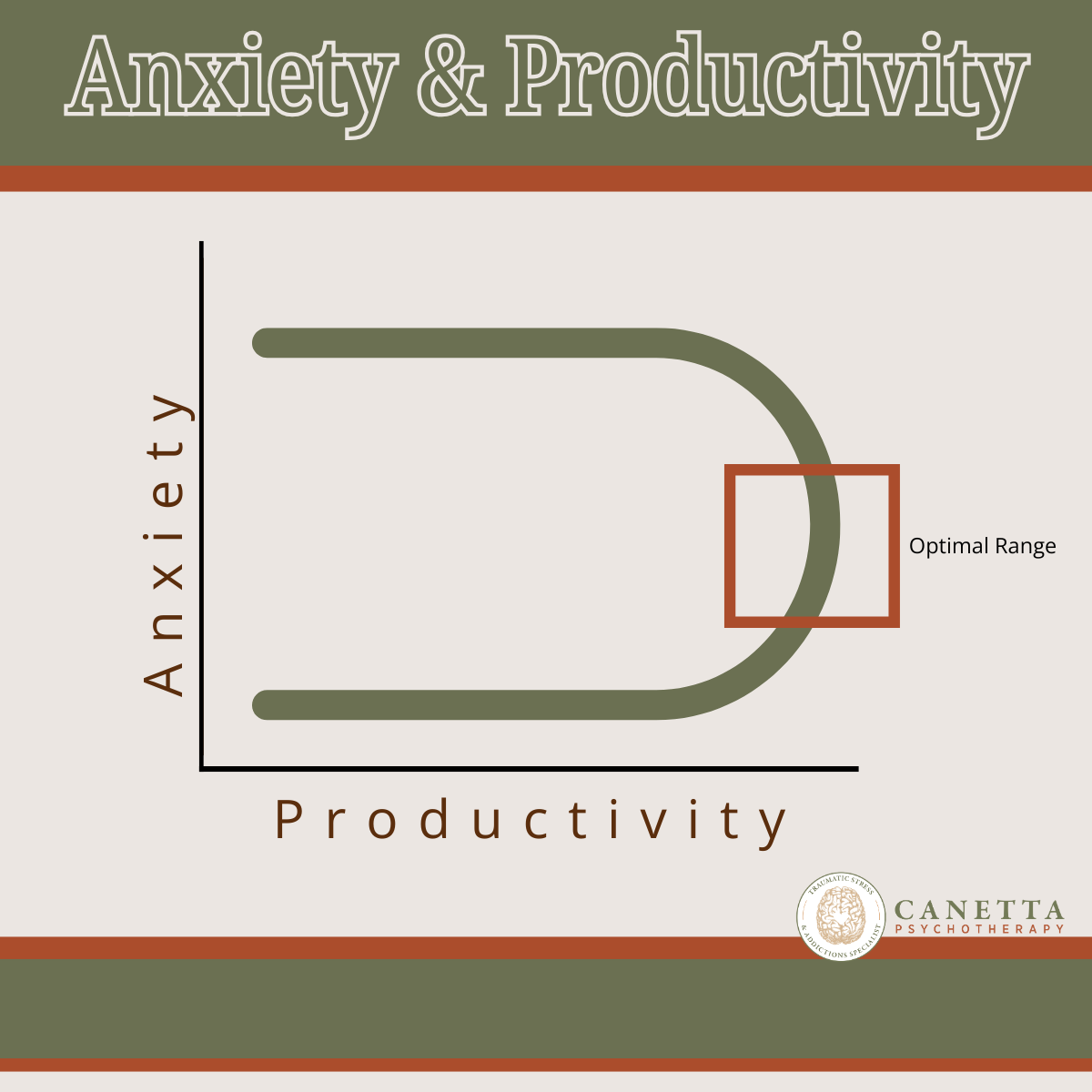
This is the point where many people say “I became so anxious and overwhelmed by everything I had to do that I got nothing done.” In that scenario the individual’s anxiety surpassed their optimal point and was detrimental to their productivity.
Pulling it All Together
I want to acknowledge that anxiety is crippling for many people. It can cause damage in our professional and personal lives and do a number on our self-esteem. and as discussed here, anxiety isn't a vestigial remnant of our past that becomes inflamed at inopportune times for some and goes unnoticed for others, like the appendix.
Anxiety developed out of a necessity to survive and at manageable levels, continues to motivate us to engage with our lives and complete tasks. It serves as our body's alarm system, pointing out danger and keeping us safe.
Unfortunately, for many, anxiety can take it too far. When it does, therapy can help to recalibrate our relationship with anxiety, giving us tools to help rewire our bodies alarm system to understand that the mundane tasks and experiences of life are not a threat just because I don't want to do them. We can retrain our autonomic nervous system to be more discerning and effective. But like it or not, anxiety will always have a place in our lives; the goal is to no longer let it run our lives.
